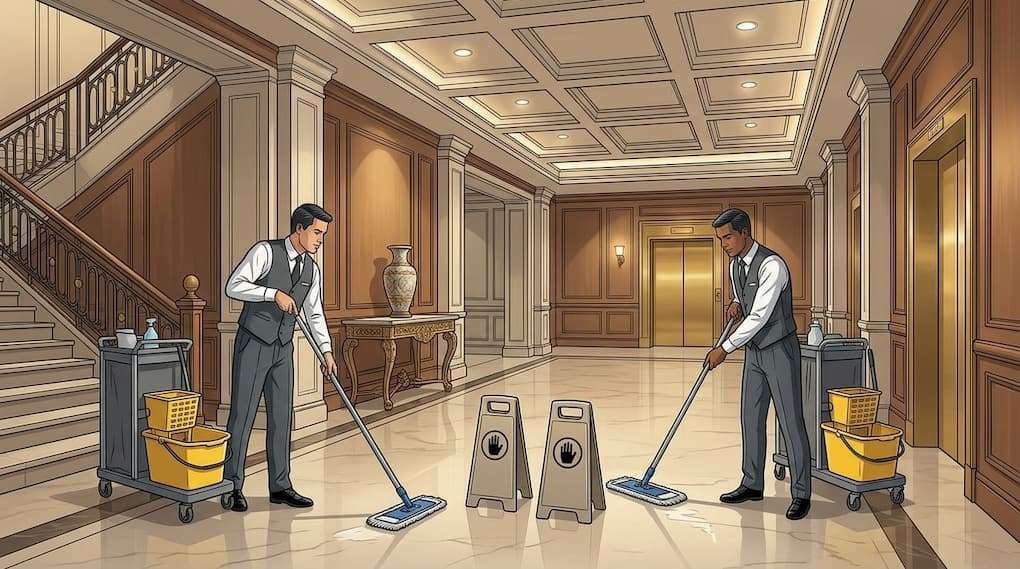
The hotel’s public area function was managed by a housekeeping supervisor whose role had been redefined over 3 years to include public area oversight as the primary responsibility. The supervisor was supported by an assistant who had been promoted to a senior attendant classification carrying partial supervisory functions. The daily cleaning team comprised 4 full-time attendants. The supervisory structure overseeing those 4 attendants had effectively become 1.5 supervisory positions against a frontline team that had not grown. The supervisory cost as a proportion of total public area labor had increased materially. The cleaning standard had not improved in proportion.
Hotel public area supervisory cost grows through reclassification and role expansion rather than through formal headcount decisions. The financial consequence is a supervisory overhead that the frontline team size and cleaning output do not justify.
Supervisory Span of Control in a Small Department
Public area cleaning teams in full-service hotels typically comprise 3 to 6 frontline attendants depending on the hotel’s size and the scope of public spaces requiring coverage. A supervisory structure appropriate for that team size is a single supervisor with a defined span of control across all frontline positions. When that structure expands to include an assistant supervisor, a senior attendant with supervisory responsibilities, or a dedicated public area manager above the supervisor level, the supervisory cost grows relative to the frontline team being supervised.
The financial signal is the ratio of supervisory hours to frontline cleaning hours. In a well-calibrated public area department, supervisory hours should represent 15% to 20% of total public area labor hours. When that ratio rises above 25%, the supervisory structure has grown beyond what the frontline team size supports. A department where 1.5 supervisory positions are overseeing 4 frontline attendants is running a supervisory ratio closer to 30%, generating overhead cost that the cleaning output the department produces cannot justify.
“The public area team had 4 cleaners and effectively 2 managers. The ratio only became obvious when we separated the supervisory hours from the frontline hours and put them side by side.”
The Reclassification Path That Creates Supervisory Cost Invisibly
Hotel public area supervisory cost typically grows through a series of individually reasonable decisions rather than through a single headcount approval. A senior attendant is reclassified to lead attendant to recognize their experience. The lead attendant takes on quality check responsibilities that are supervisory in nature. A dedicated supervisor is added when the lead attendant’s supervisory responsibilities grow to the point where they cannot clean and supervise simultaneously. Each step in that sequence looks justified in isolation. The cumulative effect is a supervisory cost structure that has grown through incremental decisions without any point at which someone reviewed the total supervisory overhead against the frontline team it was overseeing.
Tracking public area supervisory hours separately from frontline cleaning hours and expressing the relationship as a ratio produces a financial signal that the total public area labor line does not. Hotels that have built that tracking find the right trigger point for reviewing whether the supervisory structure is calibrated to the team it manages. A rising supervisory ratio against a stable frontline team is the signal that the structure has grown beyond what the operational requirement justifies. That signal requires the departmental labor cost disaggregation that hotel public area supervisory cost management delivers when the cleaning function’s cost structure is examined at the position type level rather than as a single aggregate.
“Once we separated supervisory from frontline hours, the ratio told the story immediately. The question wasn’t whether the supervisor was doing good work. It was whether the team needed the supervisory structure that had accumulated around it.”
What the Supervisory Ratio Is Telling the Department
A hotel public area department where supervisory cost represents more than 25% of total labor cost is carrying an overhead structure that the frontline team size does not require. The cleaning work is being done by the attendants. The supervisory overhead above the level that team needs represents recoverable cost. Hotels that track the ratio and set a target for it make more deliberate decisions about how supervisory responsibilities are structured, classified, and compensated within the public area function.
This Article Is Part of a Larger Series
Access the complete Hotel Labor Series