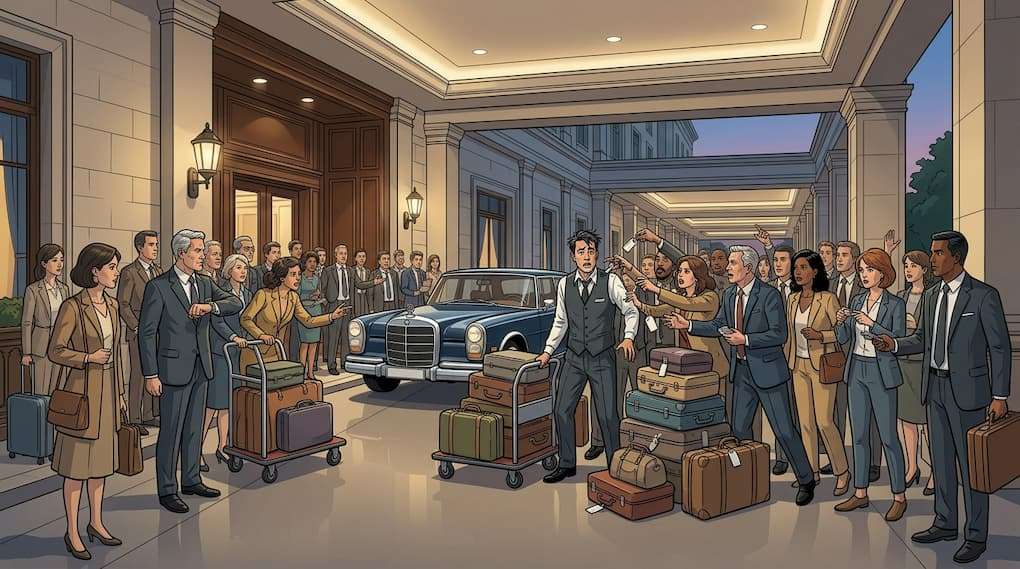
08 – When High-Traffic Event Periods Break the Hotel Public Area Staffing Model
The hotel hosted a 3-day industry conference. 800 registered attendees. The public area staffing model had been built for the hotel’s standard operat...
Get started
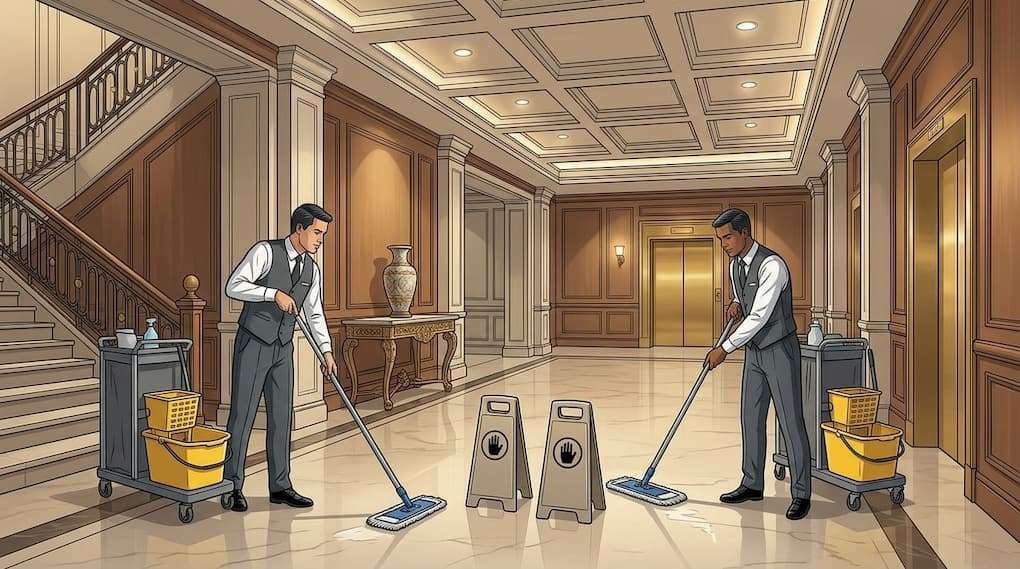
The lobby floor was cleaned by a housekeeper whose position was coded to rooms division. The lobby plants were maintained by an employee whose position was coded to engineering. The lobby attendant managing guest flow and cleanliness during peak hours reported to the front office manager and was coded to front office. The corridor carpets were cleaned by a housekeeping team position that rotated between guest corridors and public corridors depending on demand. On any given day, 4 employees from 3 departments were performing public area functions. No single department head could account for all of them. No single budget line captured their combined cost.
Hotel public area labor is not just invisible in reporting. It is actively distributed across departmental structures that have no mechanism to consolidate it, no incentive to claim it, and no accountability for its total cost.
Hotel public spaces are used by every department and owned by none. Housekeeping cleans them. Engineering maintains them. Front office manages guest interactions within them. Security monitors them. Events uses them. Each department performs public area work as a secondary function of its primary role. Housekeeping cleans public corridors between room turns. Engineering maintains lobby systems during rounds that include guest room systems. Front office manages the lobby environment as an extension of guest arrival management.
The financial consequence of that multi-department contribution is a public area cost that is visible only in fragments within each department’s budget. The housekeeping budget shows corridor cleaning hours that are difficult to separate from guest floor cleaning hours. The engineering budget shows lobby maintenance hours that are difficult to separate from guest room maintenance hours. The front office budget shows lobby attendant hours that are difficult to separate from reception function hours. The true cost of maintaining the hotel’s public spaces is the sum of those fragments, and that sum is almost never calculated.
“I asked 4 different department heads what public area labor cost us annually. I got 4 different partial answers that added up to a number none of them had ever seen as a whole.”

We help hotels control labor costs by connecting staffing, productivity, forecasting, budgets, and department-level workforce decisions to changing property demand while protecting service quality.
Learn MoreWhen public area labor is distributed across multiple departments without clear ownership, nobody is accountable for its total cost. The housekeeping manager is accountable for housekeeping labor. The engineering manager is accountable for engineering labor. Neither is accountable for the public area cost that sits in their budget as a component of their total. When the hotel’s lobby cleaning standard deteriorates, the conversation about whose responsibility it is to fix the problem produces the same fragmented response as the cost reporting. Multiple departments are partially responsible. None is fully accountable.
Establishing clear ownership of public area labor, either by creating a dedicated public area cost center or by designating a single department as the owner of record for all public area labor regardless of which department’s employees execute it, is the organizational decision that makes the financial management of the function possible. Without that ownership decision, the cost remains fragmented across departments that manage their own totals without visibility into the public area function as a whole. This is the cost center ownership structure that hotel public area labor cost accountability requires before the department’s financial performance can be actively managed rather than passively distributed.
“When we assigned public area ownership to a single manager and redirected all public area labor coding through a single cost center, the accountability conversation changed completely. There was 1 number and 1 person responsible for it.”
A hotel that cannot produce a consolidated public area labor cost because the function is distributed across 3 or 4 departments is not managing a cost center. It is managing a service standard through an organizational structure that has never been designed to produce financial visibility into the function delivering it. The organizational fix is simpler than it appears. It does not require a new department, new headcount, or a restructuring of who does the work. It requires a decision about who owns the cost of that work and a consistent coding structure that reflects that decision across every department that contributes to the public area function.
This Article Is Part of a Larger Series
Access the complete Hotel Labor Series
The hotel hosted a 3-day industry conference. 800 registered attendees. The public area staffing model had been built for the hotel’s standard operat...
Get started
The hotel’s monthly labor cost report showed housekeeping, front office, F&B, engineering, and security as distinct department lines. Public area...
Get started