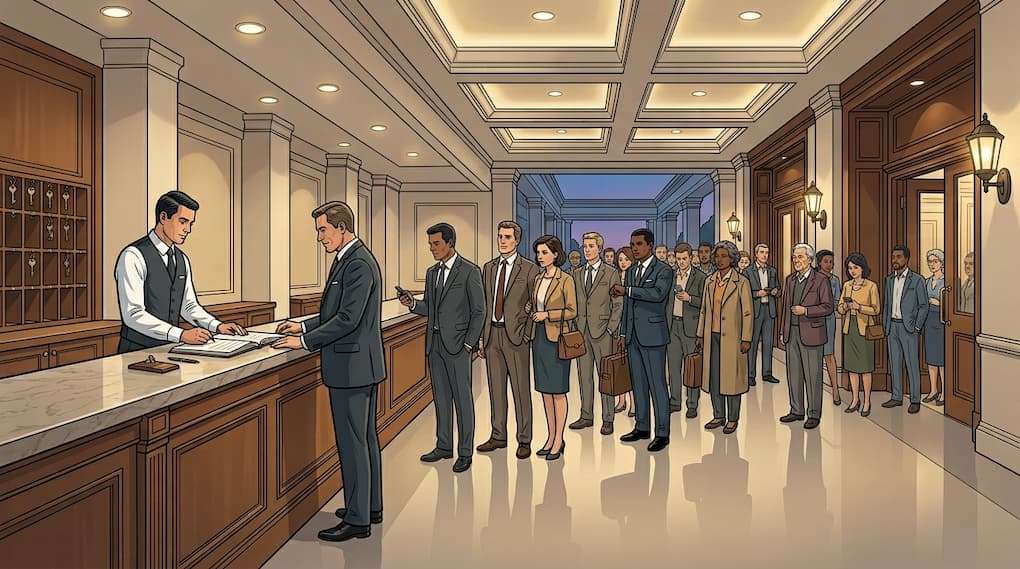
01 – Why Guest Arrival Concentration Breaks the Hotel Front Desk Labor Model
The schedule was built on occupancy. 300 rooms at 62% meant a manageable number of guest check-ins distributed across the afternoon. What it could not acco...
Get started

Occupancy dropped to 38% for the 6-week slow period the hotel experienced every January and February. Room revenue fell accordingly. Front desk labor did not. The department ran a coverage structure built on a 65% to 70% occupancy assumption, the level that defined the operational baseline for most of the year. When guest demand contracted by nearly half the staffing model did not contract with it. The labor cost remained. The revenue to justify it did not.
Front desk coverage during low occupancy is 1 of the most consistently overspent line items in hotel operations and 1 of the least examined.
Front desk departments in hotels maintain a minimum staffing floor regardless of occupancy. Someone must be at the desk at all times. A night auditor runs the overnight. A morning agent handles early guest departures and arrivals. That minimum floor is a legitimate fixed cost. The problem is not the floor. It is the coverage structure built above the floor that does not scale down when occupancy drops.
A hotel running 70% occupancy might schedule 3 agents during peak afternoon guest check-in. The same hotel at 38% occupancy schedules 2 agents, occasionally 3. The reduction is not proportional to the drop in guest demand. The scheduling logic responds to institutional comfort level rather than to the actual transaction volume the day’s arrivals will produce. What management has historically posted during that window becomes the default. The result is a coverage rate that reflects last year’s peak staffing assumption applied to this year’s slow period.
“We’d cut the desk from 3 agents to 2 during the slow period and thought we’d addressed it. The 2-agent window was still running 40% above what the guest arrivals required.”

We help hotels control labor costs by connecting staffing, productivity, forecasting, budgets, and department-level workforce decisions to changing property demand while protecting service quality.
Learn MoreThe slow period is analytically useful precisely because it compresses the gap between scheduled coverage and actual guest demand. A front desk department correctly calibrated to demand will show labor cost as a % of room revenue holding approximately constant across occupancy levels. A department running structural over coverage will show that ratio deteriorating as occupancy falls because the coverage structure does not compress at the same rate as the revenue base.
Research on hotel cost structure published by CBRE shows that rooms department labor has a significant fixed component at lower occupancy levels, costs that do not compress even when occupancy falls substantially. For full-service hotels a meaningful portion of front desk labor behaves as fixed cost below the 60% occupancy threshold. What that data does not show is whether that fixed cost reflects a genuine minimum staffing floor or a scheduling convention that was never reviewed against actual low-occupancy guest transaction volume. The difference between those 2 explanations is recoverable cost versus necessary cost.
“January was our most expensive month on a labor efficiency basis. We’d assumed it was our cheapest because it was quiet.”
Front desk managers running slow-period coverage at a level the guest demand cannot justify are making a conservative decision, not an irrational one. They hold coverage because the cost of being understaffed when demand unexpectedly spikes is visible and immediate, while the cost of being overstaffed when demand is predictably low is diffuse and absorbed silently into the labor ratio. That asymmetry in visibility drives the overspend. Hotels that track front desk transactions per labor hour during slow periods, isolating guest check-ins, check-outs, and service interactions per scheduled hour, can see the gap between coverage committed and coverage required. That is the kind of demand-to-coverage connection that hotel labor management as a financial discipline surfaces as a recoverable cost rather than an accepted condition. Hotels that quantify the slow period overspend as an absolute dollar accumulation across 6 weeks often find it material enough to warrant a formal coverage review. The number makes the decision that institutional habit would otherwise prevent.
This Article Is Part of a Larger Series
Access the complete Hotel Labor Series
The schedule was built on occupancy. 300 rooms at 62% meant a manageable number of guest check-ins distributed across the afternoon. What it could not acco...
Get started
A hotel running a 15-minute average guest check-in queue during peak afternoon hours is carrying a cost that no departmental labor report will identify. Th...
Get started