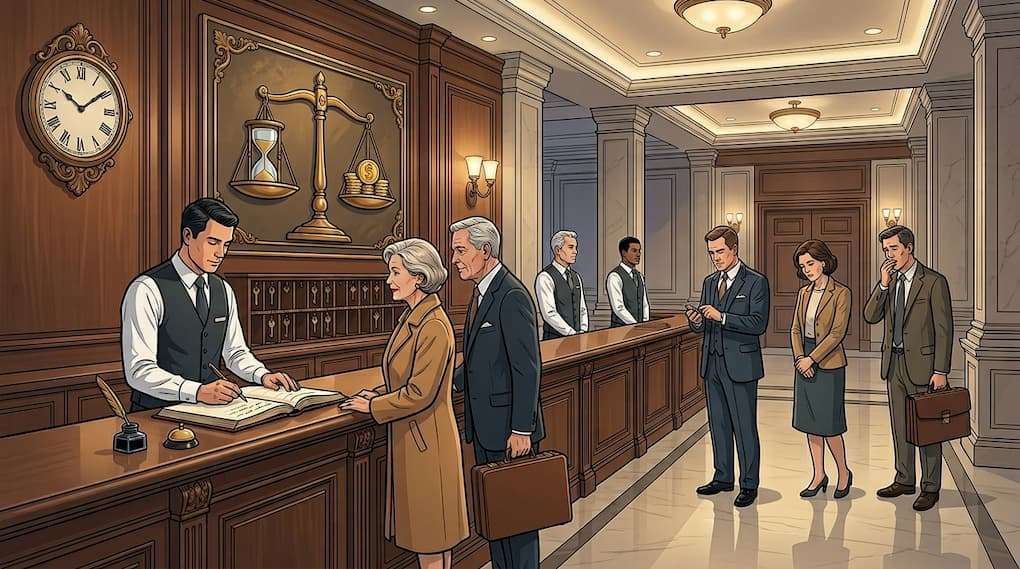
A hotel running a 15-minute average guest check-in queue during peak afternoon hours is carrying a cost that no departmental labor report will identify. The agents are on the clock. Their hours are counted. Their wage cost appears in the payroll summary. What the report does not capture is that those 15 minutes per guest represent labor deployed against a condition the staffing model was never designed to address. The downstream cost extends into service recovery, loyalty program compensation, and supervisor time that could not be recovered for any productive purpose.
Queue cost is invisible in standard reporting precisely because it is embedded in hours that look like ordinary front desk labor.
The Queue Is a Labor Efficiency Problem Presenting as a Service Problem
When guests wait at the front desk, the visible consequence is a service experience below expectation. Leadership sees satisfaction scores, comment cards, and post-stay surveys. The financial consequence is less visible and rarely attributed correctly. The agents servicing the queue are being paid to manage a condition that adequate coverage would have prevented. The hours are real. The cost is real. The attribution is wrong.
Front desk queues form when scheduled coverage cannot match the guest arrival rate during concentrated check-in windows. That gap is a staffing model problem, not a service execution problem. Hotels that treat it as a service problem invest in guest recovery. A complimentary drink, a room upgrade, or a loyalty point adjustment costs money. None of that spending addresses the scheduling decision that created the queue, and none of it surfaces in the labor cost analysis for the department.
“We tracked guest wait times for a quarter before we understood that most of the satisfaction complaints were a staffing decision made 3 weeks before the guest ever arrived.”
The Downstream Cost Multiplier
Queue-driven service failures generate costs that spread across departments and accounting periods. A guest who waits 22 minutes at check-in and receives a room not yet ready creates a service recovery chain involving the front desk supervisor, potentially housekeeping, and in some cases a complimentary room upgrade or F&B credit. Guest arrival concentration makes that sequence more likely. The credit appears in F&B costs. The supervisor time appears in front office labor. The upgrade appears in rooms revenue as a variance. No single report connects those costs to the check-in queue that generated them.
Full-service hotels typically see front desk labor account for 15% to 20% of rooms department total labor cost. Within that figure, the hours consumed managing queue recovery, supervisor escalations, and extended check-in transactions during concentrated arrival periods represent a portion that standard productivity metrics will not isolate. The ratio looks within range. Understanding where that cost originates requires the operational-to-financial tracing that hotel labor management discipline makes possible, connecting what happens at the desk to what appears weeks later in the financials.
“The cost of the queue doesn’t show up in 1 place. It shows up in 5 places, and none of them point back to front desk scheduling.”
What the Queue Signals About the Staffing Model
A recurring afternoon queue is not a random event. It is evidence of a staffing model built on daily averages applied to guest demand that does not behave as an average. When leadership understands the queue as a structural signal rather than an operational failure, the financial response changes. The question shifts from how to recover from guest dissatisfaction to why the coverage decision was made against an assumption the arrival pattern consistently disproves. Hotels that have mapped their service recovery costs back to operational causes consistently find that front desk queue events are among the highest-cost triggers in the building.
This Article Is Part of a Larger Series
Access the complete Hotel Labor Series