
02 – When Hotel Check-In Queue Cost Does Not Appear in the Labor Report
A hotel running a 15-minute average guest check-in queue during peak afternoon hours is carrying a cost that no departmental labor report will identify. Th...
Get started
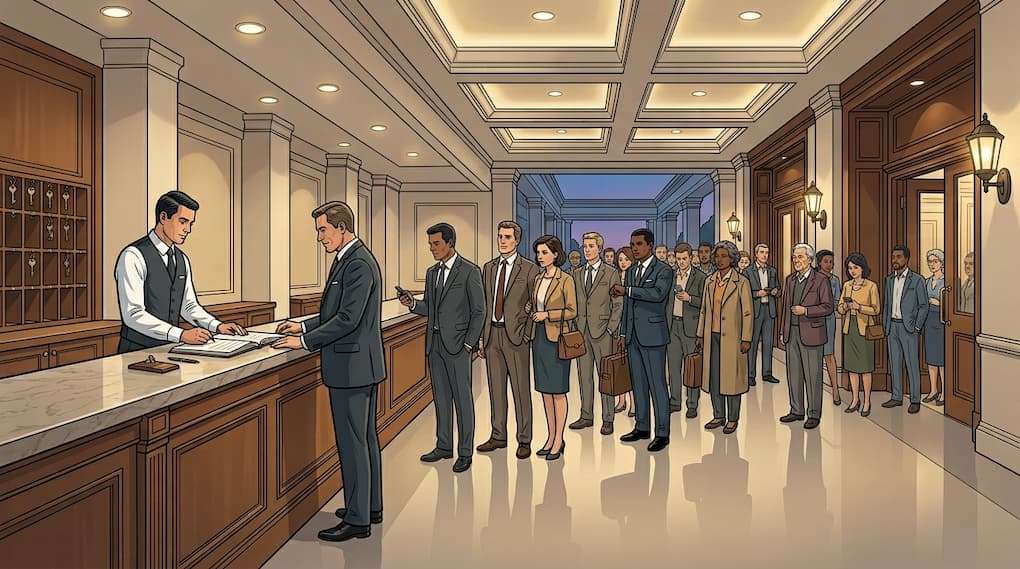
The schedule was built on occupancy. 300 rooms at 62% meant a manageable number of guest check-ins distributed across the afternoon. What it could not account for was that 211 of those arrivals landed between 3:00 PM and 5:30 PM. The agents on duty handled it. Barely. Extended shifts, unplanned supervisor coverage, and a call-in at a premium rate followed. None of that cost appeared anywhere in the department’s efficiency metrics.
This is the financial signature of guest arrival concentration in hotel operations. The occupancy number looks manageable. The labor cost is not.
Front desk labor is typically scheduled against a room count. A hotel running 60% occupancy on a Tuesday expects a lighter day than a Friday at 80%. The scheduling logic follows the number, not the shape of guest demand. That distinction matters financially because 2 hotels with identical occupancy can generate dramatically different front desk labor costs depending entirely on when guests arrive.
Compressed guest arrival windows force coverage decisions that cannot be undone once the shift is posted. A 2-hour arrival spike requires enough agents to service the queue without allowing wait times to deteriorate guest satisfaction scores. That minimum coverage threshold does not scale down when arrivals slow. The hotel has already committed the hours. A delayed flight pushing an international group into late afternoon generates shift extensions that nobody budgeted. A highway closure backing leisure travelers into the same 90-minute window produces the same result. The occupancy figure is unchanged. The labor cost is not.
“We kept looking at the day’s total guest arrivals and thinking we’d staffed it correctly. We hadn’t. We’d staffed the average, not the 2 hours that actually mattered.”
Labor reports for front office departments typically show total hours paid, total rooms checked in, and a resulting productivity ratio. None of those metrics surfaces what happened between 3:00 PM and 5:30 PM. The ratio absorbs the spike. The shift extension gets coded to the correct cost center. The call-in appears as a regular wage line. Nothing flags the condition that produced those costs, and nothing connects the guest arrival pattern to the financial outcome.
This is why the condition persists. Hotels that track guest arrival density by hour rather than by day can see the gap between scheduled coverage and actual demand volume. The summary averages across the full shift and consistently understates the financial exposure that concentrated demand creates.
The cost compounds further when group arrivals land on a transient-dominant day. A 30-room block checking in simultaneously does not behave like 30 individual guest arrivals spread across 2 hours. It requires dedicated agent capacity, pre-assigned room blocking, and housekeeping coordination on room readiness. When room readiness is not confirmed before the group arrives, the front desk absorbs service recovery labor while housekeeping absorbs the pressure of accelerated room turns. Both departments pay. Neither report shows the cause.
“The group was supposed to check in at 4:00. They showed up at 2:15. We had 2 agents and a trainee.”
The distinction between volume-based and shape-based front desk planning produces different coverage decisions, different cost outcomes, and different financial performance. Hotels that connect hourly guest arrival data to scheduling decisions stop absorbing the cost of concentration after the fact. This is the discipline that hotel labor management as a financial practice demands. Tracking total labor against total output is not enough. The question is which operational conditions create cost exposure that aggregate reporting will never surface.
Front desk labor as a % of room revenue tends to look acceptable at the hotel level because the revenue base is large enough to absorb departmental inefficiency. What that ratio does not reveal is that 2 hours of concentrated guest arrivals every afternoon are generating labor costs the remaining 6 hours of the shift cannot offset.
This Article Is Part of a Larger Series
Access the complete Hotel Labor Series

We help hotels control labor costs by connecting staffing, productivity, forecasting, budgets, and department-level workforce decisions to changing property demand while protecting service quality.
Learn More
A hotel running a 15-minute average guest check-in queue during peak afternoon hours is carrying a cost that no departmental labor report will identify. Th...
Get started
The night audit shift starts at 11:00 PM and runs to 7:00 AM. The posting is consistent. The headcount is consistent. The cost, examined over 12 months, is...
Get started