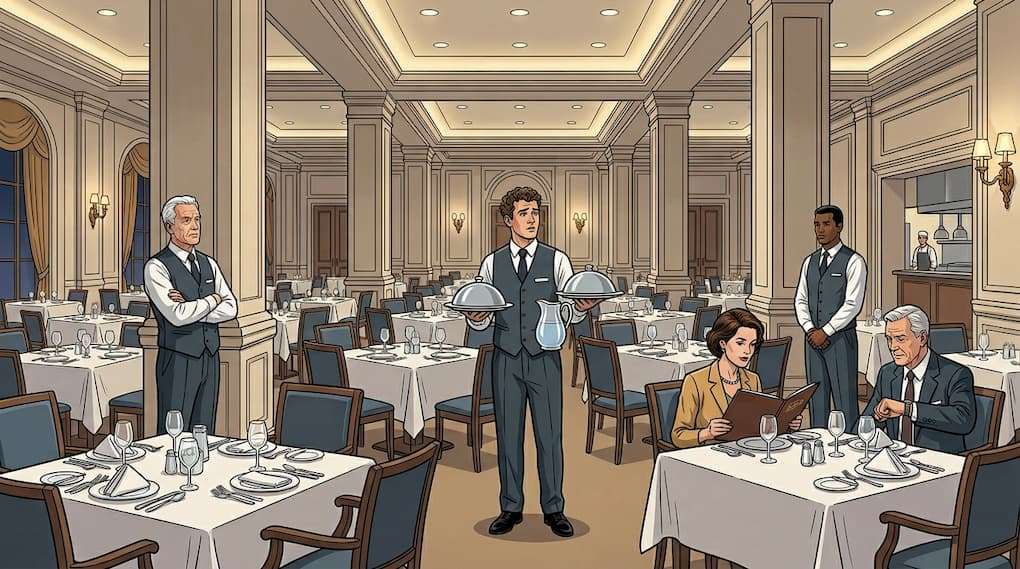
01 – When Hotel Restaurant Labor Cost Rises Without Cover Volume to Explain It
The hotel restaurant finished the quarter with labor cost up 11% versus the prior year. Cover volume was up 3%. Revenue was up 4%. The F&B director rev...
Get started
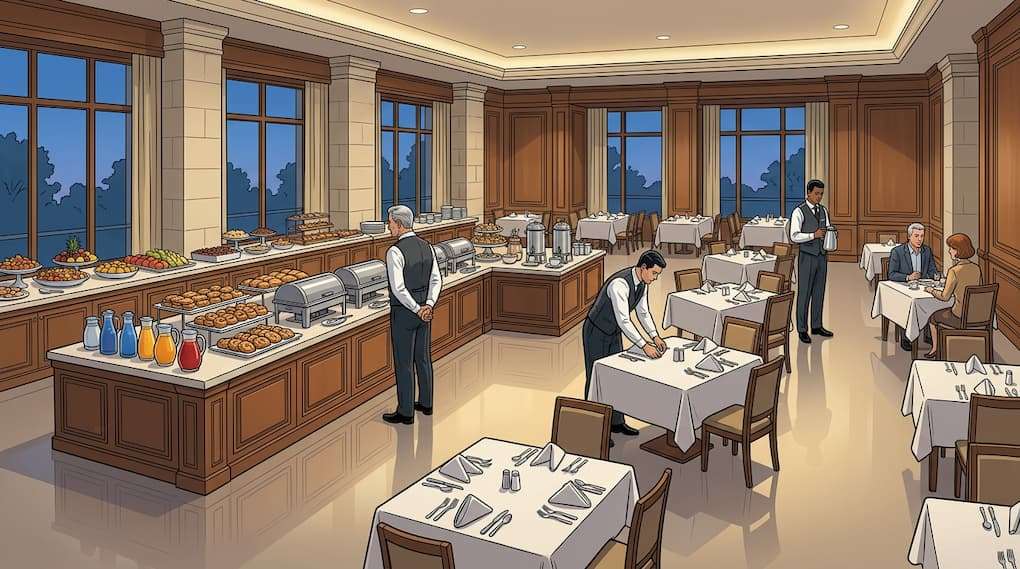
The hotel restaurant breakfast service ran from 6:30 to 10:30 daily. It required 4 servers, 3 kitchen staff, and 1 supervisor for a total of 8 positions across the 4-hour period. Breakfast generated an average of 68 covers per service at an average check of $24. Daily breakfast revenue averaged $1,632. The labor cost of the 8-position breakfast team across the 4-hour service was $784 at a blended rate of $24.50 per hour including benefits. Breakfast labor represented 48% of breakfast revenue before food cost, overhead, or any other operating expense was included. The hotel’s F&B department reported labor as a percentage of total daily F&B revenue. Breakfast’s 48% labor ratio was averaged into the dinner ratio of 28% to produce a combined daily figure of 36% that sat within the acceptable range.
Hotel breakfast service labor cost is structurally the most difficult daypart to justify financially in a full-service hotel restaurant. The averaging of breakfast into the total F&B labor ratio is the financial mechanism that keeps the condition invisible.
Hotel breakfast service is operationally different from dinner in ways that directly affect its labor economics. Average check is lower, typically 25% to 30% of a dinner check in a full-service hotel restaurant. Service duration per cover is shorter, but setup and breakdown relative to the service window are proportionally larger. The kitchen requirement for breakfast, which typically involves more stations for eggs, pastry, and hot items, does not compress proportionally with the lower average check. A breakfast kitchen running 3 positions to serve 68 covers is generating kitchen labor cost against a revenue base that a dinner kitchen running 6 positions to serve 180 covers at $85 average check recovers far more efficiently.
The financial condition that makes breakfast difficult is not the service standard or the cover volume in isolation. It is the combination of low average check, short service window, high setup and breakdown labor relative to productive service time, and a kitchen structure that has a minimum staffing floor regardless of cover count. Each of those factors pushes the breakfast labor ratio higher than the dinner ratio. Together they produce a daypart labor cost that the breakfast revenue cannot absorb at the margin level the combined F&B target implies.
“Breakfast was subsidized by dinner in every financial report we produced. The subsidy was invisible because we never built a breakfast P&L. When we did, the conversation about breakfast changed entirely.”

We help hotels control labor costs by connecting staffing, productivity, forecasting, budgets, and department-level workforce decisions to changing property demand while protecting service quality.
Learn MoreHotel breakfast service has a cost floor that dinner does not. A breakfast operation that opens at 6:30 requires kitchen staff present by 5:30 or 6:00 for setup. Setup labor is paid labor against a service period that has not yet generated any revenue. A dinner operation that opens at 6:00 has a preparation window that is absorbed by prep cooks whose time is distributed across both lunch prep and dinner setup. The breakfast setup labor is unique to the breakfast period and falls entirely within its cost structure.
Similarly, breakdown after the 10:30 breakfast close requires kitchen and floor staff to remain beyond the last cover. If that labor is paid through 11:00 or 11:30 to complete cleaning and reset for lunch, the breakfast period’s effective labor window is 5 to 6 hours against a revenue-generating service window of 4 hours. The pre-open and post-close labor extends the daypart cost without extending the daypart revenue.
Building a standalone breakfast P&L that captures all labor attributed to the daypart, including pre-open setup and post-close breakdown, and places it against breakfast revenue alone, produces a financial picture of the breakfast operation that the combined F&B ratio cannot provide. Hotels that have built that P&L find that breakfast labor-to-revenue ratios of 45% to 55% are common in full-service hotel restaurants. That finding does not necessarily mean breakfast should be eliminated or dramatically scaled back. It means the hotel understands what breakfast actually costs, can make deliberate decisions about the service model, and can price any complimentary breakfast inclusions or package rates against the true cost of providing them. This is the daypart financial clarity that hotel F&B breakfast service labor cost and daypart P&L produces when each service period is evaluated on its own financial terms rather than averaged into a combined outlet result.
“When we saw the standalone breakfast P&L for the first time, the first question was whether the complimentary breakfast we were offering certain rate categories was priced to recover what it actually cost us. It was not.”
A hotel restaurant breakfast service running a 48% labor-to-revenue ratio is telling a specific financial story about the daypart: the revenue it generates does not cover the cost of the service model delivering it at a margin that contributes to the hotel’s financial performance. Hotels that know that number make deliberate decisions about whether to maintain a full-service breakfast, convert to a buffet model with lower labor intensity, adjust the pricing of rate inclusions that promise complimentary breakfast, or accept the breakfast loss as a guest experience investment with a defined and understood cost. Hotels that do not know the number are making those decisions on assumptions that the combined F&B ratio has never tested.
This Article Is Part of a Larger Series
Access the complete Hotel Labor Series
The hotel restaurant finished the quarter with labor cost up 11% versus the prior year. Cover volume was up 3%. Revenue was up 4%. The F&B director rev...
Get started
The hotel restaurant ran 3 service periods daily. Breakfast from 6:30 to 10:30. Lunch from 11:30 to 2:30. Dinner from 6:00 to 10:00. The F&B director r...
Get started