
08 – When Hotel Outsourced Concierge Services Cost More Than In-House Delivery
The outsourcing proposal showed a cost reduction of $47,000 annually against the current concierge payroll. The vendor would provide trained concierge staf...
Get started
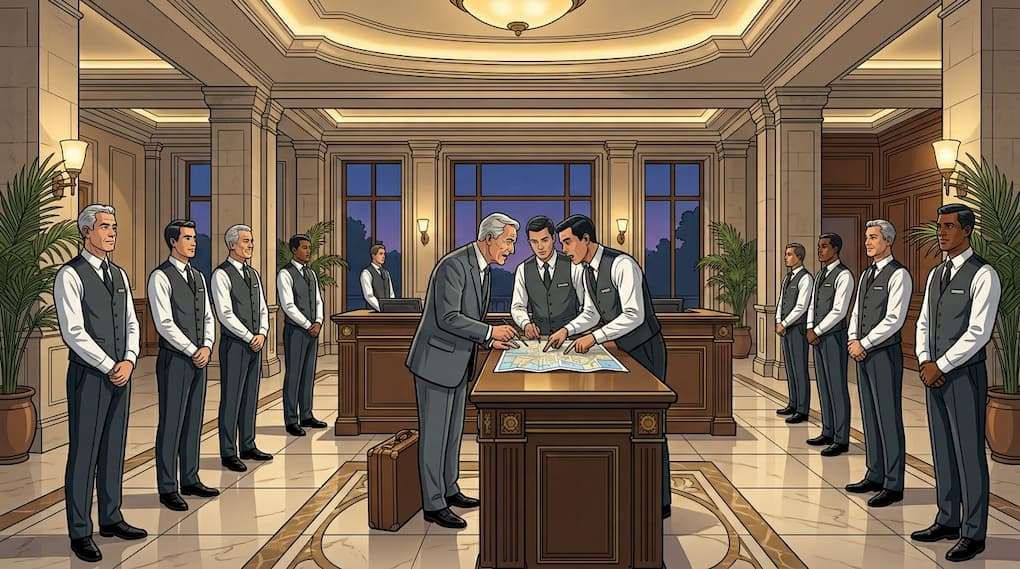
A guest approached the front desk at 4:00 PM to ask for a restaurant recommendation. The front desk agent spent 7 minutes providing recommendations, making a call to confirm availability, and booking the reservation. At the same time, the concierge desk 15 feet away was handling a different guest interaction. Neither department logged the other’s activity. The front desk reported the check-in it completed. The concierge reported the interaction it handled. The 7-minute restaurant booking absorbed by the front desk agent appeared nowhere as a concierge function performed by a non-concierge employee. This happens dozens of times a day in full-service hotels.
Concierge and front office functions overlap constantly in hotel operations. The labor cost of that overlap is absorbed by both departments simultaneously, without either having visibility into what the other is doing on behalf of the same guest service function.
Hotel organizational charts draw a clear line between the front desk function and the concierge function. In practice that line disappears the moment a guest approaches the front desk with a request that belongs operationally to the concierge, or the moment a concierge handles a check-in inquiry that belongs to the front desk. Both situations happen continuously. Front desk agents answer concierge-type questions because the guest is standing in front of them. Concierge agents assist with front desk-type inquiries because the front desk is occupied.
The labor cost of those crossovers is absorbed by whichever department’s employee is performing the function at that moment. The front desk budget absorbs the restaurant booking. The concierge budget absorbs the check-in status inquiry. Neither department tracks the activity as belonging to the other. Neither can tell how much of its daily labor hours are being spent on functions that theoretically belong to the adjacent department. The overlap is real. The visibility into it is zero.
“We knew the departments worked closely together. What we didn’t know was how many hours each of them was spending doing the other one’s job. When we tracked it, the number surprised both department heads.”

We help hotels control labor costs by connecting staffing, productivity, forecasting, budgets, and department-level workforce decisions to changing property demand while protecting service quality.
Learn MoreLabor overlap between concierge and front office creates a specific financial condition: both departments are staffed to perform functions that both are routinely performing. The coverage rationale for each department includes the full scope of its defined function. But if the front desk is performing 20% of the interactions that would otherwise go to the concierge, the concierge staffing calculation contains a demand assumption that actual guest behavior does not support. The same logic applies in reverse. The result is both departments carrying more coverage than their exclusive functions require, because neither has accounted for the cross-pollination that actually governs how guests use both desks.
Tracking which functions each department is actually performing, as distinct from what their job descriptions say they perform, produces a staffing picture that organizational charts never show. Hotels that have done this analysis consistently find that the labor cost of the overlap, measured in hours each department spends on the other’s defined functions, is large enough to affect staffing decisions for both departments. That analysis requires observational data that standard labor reporting does not capture. It requires the kind of operational function-to-cost mapping that hotel departmental labor cost analysis applies when the financial question is where the hours are actually going rather than where the org chart says they should go.
“The concierge and front desk were both good at their jobs. They were also each spending roughly 25% of their time on the other department’s job. That’s a staffing conversation neither department had ever had.”
A front office department and a concierge department that are each performing a significant portion of the other’s defined functions are not 2 distinct departments for staffing purposes. They are 1 integrated guest services function that has been organized into 2 separate budget lines. Hotels that recognize that reality make different decisions about relative headcount, desk positioning, cross-training investment, and which functions should formally sit in which budget. Hotels that do not recognize it staff both departments against their full theoretical function and absorb the cost of the duplication in both labor budgets indefinitely.
This Article Is Part of a Larger Series
Access the complete Hotel Labor Series
The outsourcing proposal showed a cost reduction of $47,000 annually against the current concierge payroll. The vendor would provide trained concierge staf...
Get started
The concierge desk handled 340 guest interactions in a week. Restaurant reservations, activity bookings, transportation arrangements, and local recommendat...
Get started